Case - Hydrumedical
HydruSensor: wireless urodynamic exams, even at home.
Hydrumedical had the hardware to modernise urodynamic exams — Bluetooth sensors instead of wires and dated machines. What was missing was the software that makes it a real experience: apps for the patient, the technician and the clinic, and a system that ties it all together. We built that layer — including letting the exam continue at home.
01
The idea
Urodynamic exams were done wired to a dated interface — uncomfortable for the patient and impractical for the technician. Hydrumedical set out to change that with HydruSensor: Bluetooth sensors that replace the wires, and a modern interface for those running and those receiving the exam.
The idea went further than comfort. With wireless sensors, the patient can take the device home and collect data that otherwise wouldn't exist — the exam is no longer stuck in the clinic.
02
The blocker
Having the sensor is half the way. For this to be a real healthcare product, the surrounding software was missing: an app where the technician runs the exam and reads the sensors over Bluetooth in real time; a way for the exam to continue at home without losing data; a simple app for the patient to log what they feel; and a backend that ties clinics, doctors, patients and reports together. Without that layer, the sensor is just a sensor.
03
The path
We thought the whole product through — architecture, clinical flows, integrations and design.
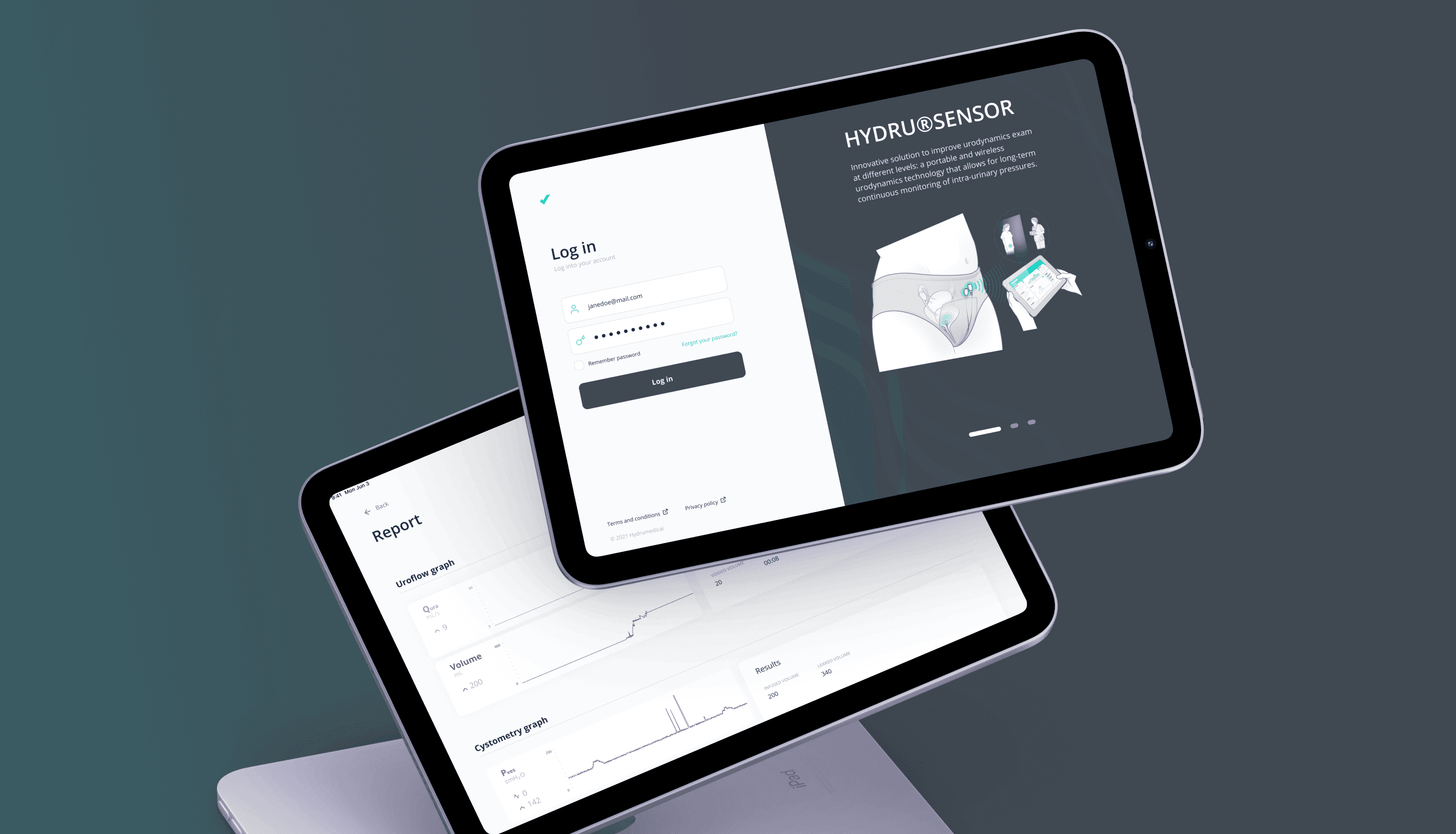
In the clinic, an app (React Native, on iPad) connects to the sensors over Bluetooth, reads the signals in real time — pressure, flow — marks events and records the exam. Behind it, a backend (NestJS, GraphQL, MongoDB) handles patients, exams, sensors and reports.
The part that changes the game is the home environment. The exam can be paused and continue at home: the system generates a code, the patient takes the sensor, the sensor keeps collecting, and in a dedicated app the patient logs sensations through the day. On return, the sensor data and the patient's notes are reintegrated into the exam, aligned chronologically to the second.
On top, role-based backoffices — administration, clinic and healthcare professional — and the exam report with the urodynamic charts, ready to export.
04
Today
Today HydruSensor is a working platform: the technician runs the exam wirelessly, the patient can continue it at home, and the doctor gets the report with all the data. An exam that used to be stuck to a machine now follows the patient.
If you have a hardware innovation — a device, a sensor — what separates the prototype from the product is, almost always, the software layer around it: the apps, the integrations, the experience. That's what we built with Hydrumedical.